The Toyota Camry That Wouldn't Rev Past 3000 RPM — A Real Diagnostic Case Study from Sunshine North
Every now and then a car rolls into the workshop with a problem that keeps you on your toes. This was one of those days.
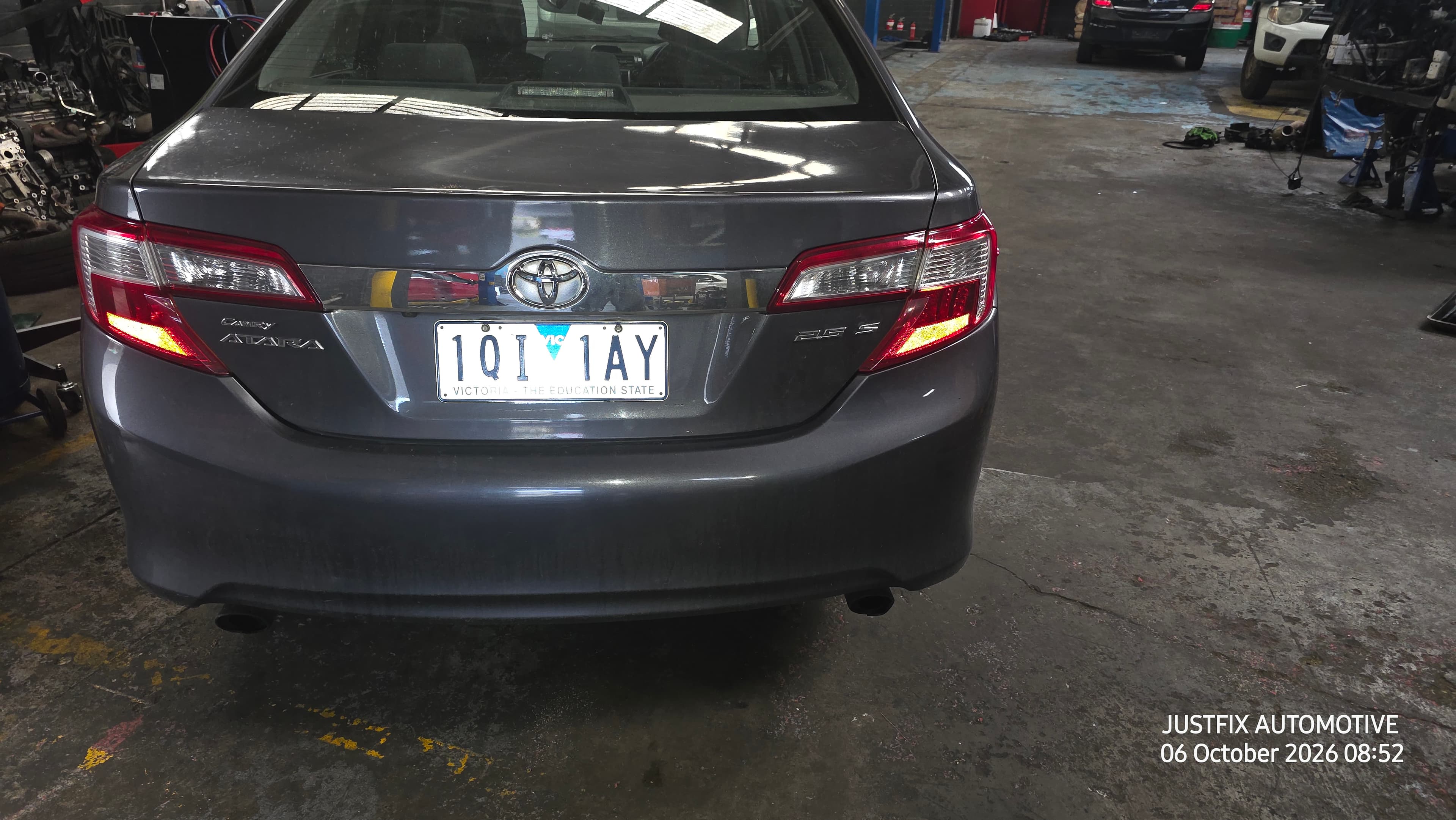
A 2013 Toyota Camry was driven into our Sunshine North workshop by a customer who was understandably frustrated. The car simply would not accelerate above 30 km/h, and the RPMs refused to climb above 3000. It wasn't overheating. It wasn't making any dramatic mechanical noises. It just felt like the engine was trying to breathe through a straw.
What followed was one of the most satisfying multi-fault diagnostic jobs we've run. It is a story that starts with worn spark plugs and low fuel pressure, takes a detour through a borescope camera, and ends with a melted catalytic converter that nobody expected to find.
We are sharing this because it perfectly illustrates why proper diagnostic technique matters—and why skipping regular maintenance on a highly reliable car like a Camry can quietly snowball into a complex, expensive repair.
The Complaint — And Why We Always Confirm It on the Road First
The customer's description was straightforward: the car wouldn't accelerate properly, wouldn't exceed 30 km/h, and felt like it hit a brick wall around 3000 RPM. There were no warning lights and no smoke.
Before picking up a single tool, we took it for a road test.
A road test is critical because it confirms the fault is real and establishes exactly how it occurs under load. It provides physical feedback that a digital scan tool simply cannot capture—how the engine sounds, whether the restriction feels mechanical or fuel-related, and if the power loss is progressive or sudden.
The road test confirmed the customer's exact complaint. Throttle input beyond 3000 RPM produced absolutely no additional response; the engine felt completely strangled.
The First Clue — Fault Code P1604
Back in the workshop, we plugged in our professional diagnostic scanner. It returned one active fault code: P1604 — Startability Malfunction.
P1604 is a Toyota-specific code indicating that the engine management system has detected conditions preventing reliable starting or stable engine operation. It is a broad, fundamental code that frequently travels alongside other faults and serves as a signal to dig deeper into the fuel and ignition systems, rather than a direct instruction to replace a specific part.
Crucially, the customer had also mentioned the car was "starting a bit funny" lately—cranking significantly longer than usual before firing up. Combined with the P1604 code, this directed our focus straight to the ignition and fuel delivery systems.
Discovery One — Completely Worn Spark Plugs
We pulled the spark plugs and found them worn completely beyond specification.
The electrode gaps had opened up to the point where consistent ignition was impossible, particularly under load when higher cylinder pressures demand a stronger spark. Misfiring caused by faulty spark plugs produces a rich air-fuel ratio. This sends excess unburned fuel directly into the exhaust system, generating extreme heat that damages downstream components.
Spark plugs are one of the most frequently overlooked maintenance items on reliable modern vehicles. While Toyota recommends replacing standard copper plugs at 80,000 km (and iridium plugs up to 160,000 km), these were severely overdue. We noted them for replacement, but we knew worn plugs alone wouldn't create a hard 3000 RPM ceiling.
Discovery Two — Low Fuel Pressure and a Rapid Pressure Drop
Next, we attached a mechanical fuel pressure gauge directly to the fuel rail to measure exactly what the system was delivering.
The reading at idle: 3 bar (300 kPa).
The factory specification: 3.5 bar (350 kPa).
This 14% shortfall is enough to cause lean running, hard starting, and hesitation under high-load conditions where injectors demand maximum fuel.
However, the most significant finding occurred upon shutting off the engine. The fuel pressure plummeted rapidly from 3 bar to 2 bar within seconds. A healthy fuel system holds residual pressure after shutdown thanks to a check valve inside the fuel filter assembly. Because this valve was failing, the engine had to re-pressurize the entire fuel rail from scratch every time the key was turned, explaining the long cranking times.
The customer could not confirm if the fuel filter had ever been replaced.
Why Regular Fuel Filter Maintenance Matters
A fuel filter that is overdue for replacement restricts fuel flow and reduces delivery pressure. Below a certain threshold, this causes lean running—the engine simply isn't getting enough fuel to match the incoming air.
Because the Camry's fuel filter is integrated into the sub-tank assembly inside the fuel tank, it is completely out of sight for most owners. Ignoring it creates a compounding chain reaction:
Short-term: Hard starting and slight hesitation.
Medium-term: The fuel pump overheats and wears out prematurely as it fights to push fuel through the blockage.
Long-term: Debris bypasses the failing filter, clogging precision fuel injectors and causing severe misfires.
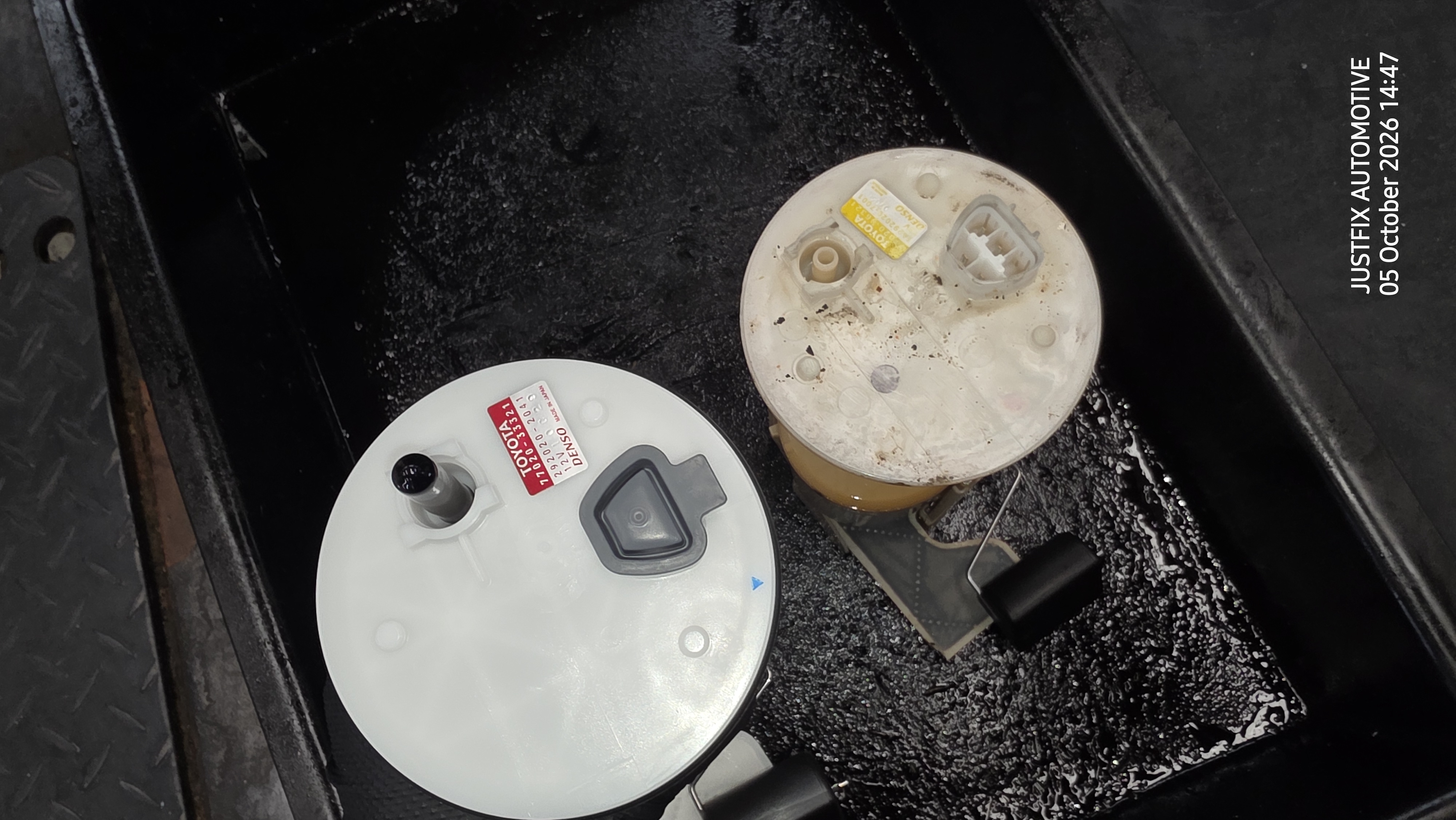
We advised the customer that the entire fuel filter assembly needed replacement. We strictly recommended a genuine Toyota part ($711.62 + GST), as aftermarket substitutes in sub-tank assemblies carry too high a risk of interface failure.
After the Fuel Filter — The Invisible Wall Remained
With a new genuine fuel filter assembly installed, the fuel pressure returned to a perfect 3.5 bar and held pressure perfectly upon shut-off. We also fitted brand new spark plugs. The engine started crisply on the first crank.
We took the car back on the road. It was noticeably smoother, but the 3000 RPM ceiling was still there. Under load, it hit the exact same invisible wall.
At this stage, less experienced technicians might start firing the "parts cannon"—guessing and replacing mass airflow sensors or throttle bodies. Instead, we returned to first principles.
Discovery Three — All Four Cylinders Misfiring Under Load
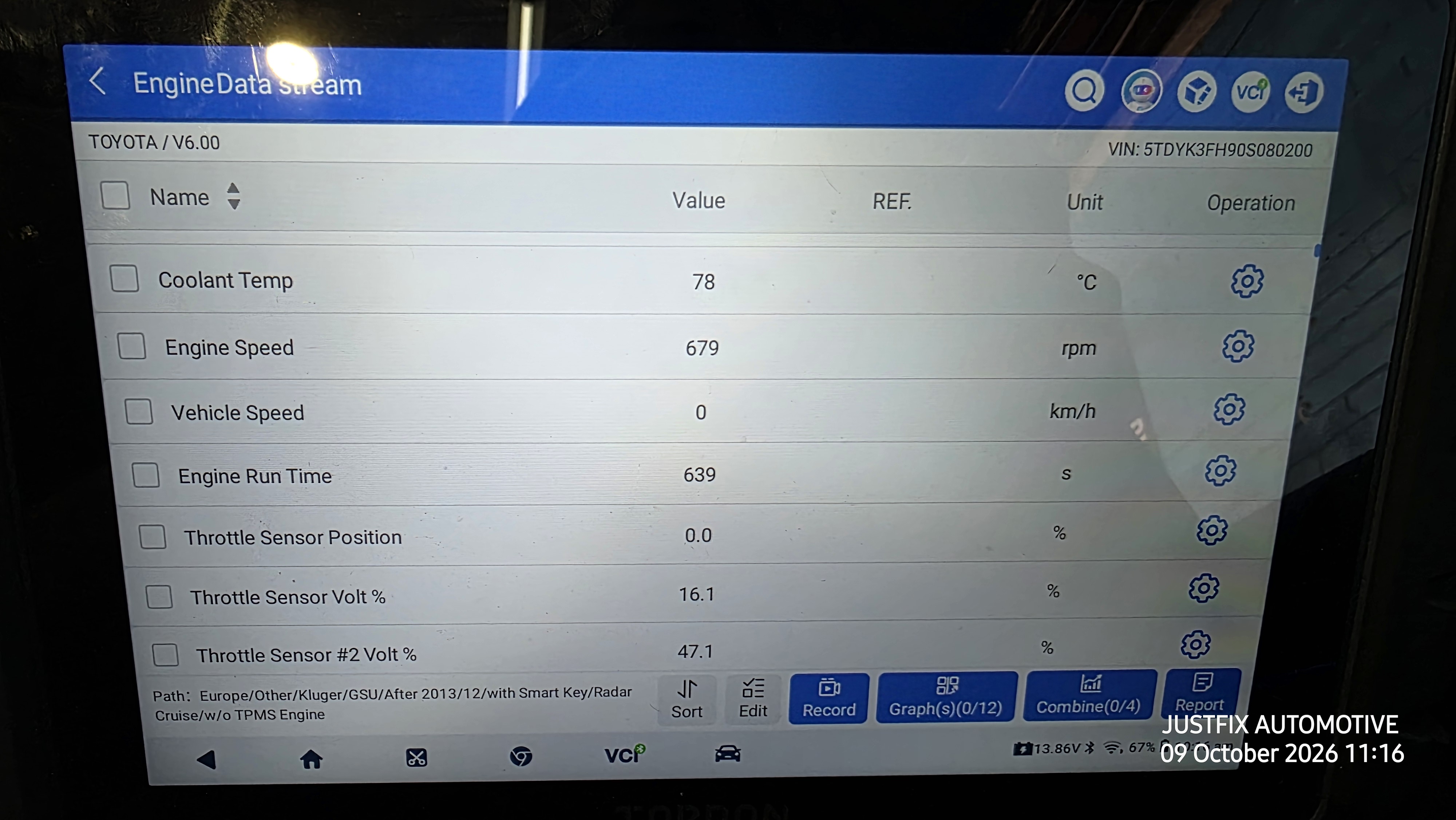
We connected our live data scanner and drove the vehicle under heavy load.
Fuel trims: Normal.
MAF sensor: Normal.
Crank/Cam sensors: Clean signals.
Injector pulse width: Normal.
The engine management system believed everything was perfect. Yet, the engine was misfiring across all four cylinders simultaneously under load.
When all cylinders misfire together (rather than a random or single-cylinder misfire), the issue is rarely internal to the engine. It points to a global restriction affecting the entire system—usually the air supply or the exhaust. Since we had already verified the air and fuel data, the exhaust system became our primary suspect.
The Clue Nobody Expected — Extreme Exhaust Heat
We removed the exhaust heat shield and ran the engine for just 60 seconds. The exhaust manifold temperature was extraordinarily high—radiating a level of heat that was immediately and obviously abnormal for a cold start.
On this Camry, the catalytic converter is bolted directly to the front-mounted exhaust manifold. This makes it fantastic for emissions, but incredibly difficult to inspect visually without removing the shielding. Restriction here can become so severe that the engine stalls, or so mild that the driver barely notices a power loss during acceleration. The most definitive test for exhaust backpressure involves testing pressure through the upstream oxygen sensor port.
We went straight to the source.
The Borescope Revealed Everything
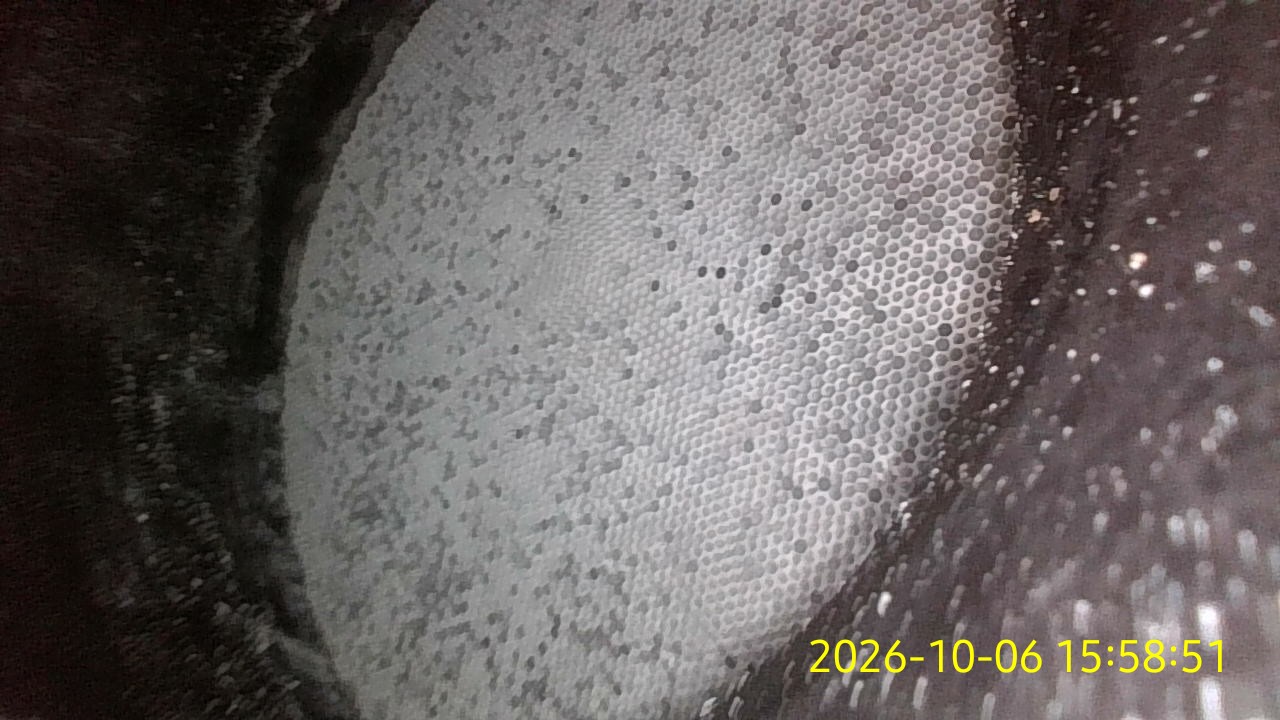
We removed the upstream (Bank 1, Sensor 1) oxygen sensor and inserted a high-definition borescope camera directly into the catalytic converter.
A healthy catalytic converter features a pristine ceramic honeycomb structure. What our camera revealed was a completely melted, collapsed, and blocked substrate.
Burning oil or unburned fuel entering the catalytic converter causes it to run exponentially hotter than designed. This extreme heat damages the substrate, melting it into a solid mass that physically chokes exhaust flow.
This was the exact cause of the 3000 RPM ceiling. Every time the driver pressed the accelerator, exhaust pressure built up violently behind the melted blockage. The ECU, sensing these abnormal conditions, cut engine output to protect itself. The engine's attempt to rev was literally being suffocated by its own exhaust.
The Chain Reaction of Failure:
Worn spark plugs caused incomplete combustion, dumping unburned fuel into the exhaust.
The clogged fuel filter caused lean/rich compensation cycles, pushing even more unburned fuel downstream.
Over months, this raw fuel superheated the catalytic converter.
The honeycomb substrate melted and collapsed, choking the exhaust.
This extreme backpressure caused all-cylinder misfires and a hard 3000 RPM limp-mode ceiling.
The Fix — Sourcing a Quality OEM Converter
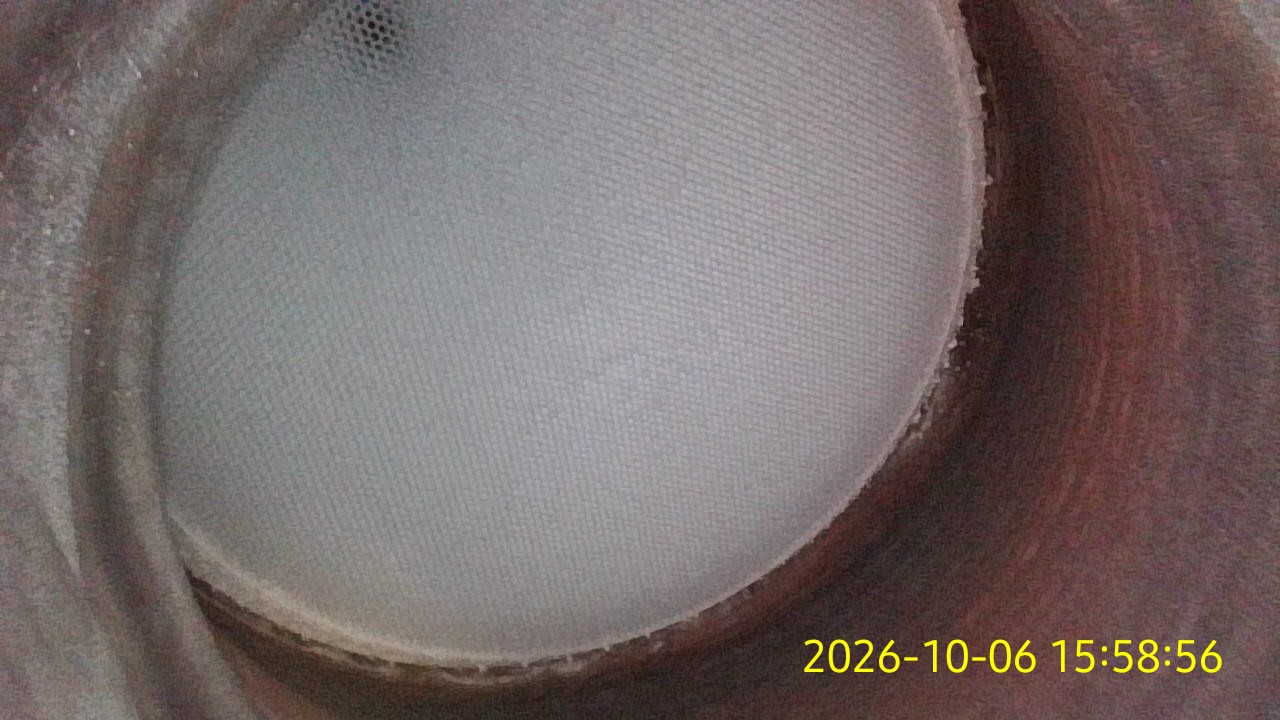
The repair path was definitively confirmed. We sourced a premium second-hand OEM Toyota catalytic converter.
If considering a used converter, it should only be sourced from a verified low-mileage vehicle wrecked in a rear or side collision—never from a car with engine failure. We inspected the replacement honeycomb structure thoroughly to ensure it was completely intact with zero signs of melting or clogging before installation.
We fitted the replacement converter, reinstalled the O2 sensor, and cleared the ECU adaptations.
The result? Immediate, dramatic restoration of power. The car pulled cleanly to the redline with full throttle response. The P1604 code, the misfires, and the speed limitations were completely gone.
What This Case Study Teaches Every Car Owner
This job is a masterclass in how deferred, invisible maintenance compounds into massive repair bills. Catching problems early restores power, saves fuel, and prevents catastrophic damage to sensors and exhaust components.
The Fuel Filter: Never replaced. If caught during a routine service via a simple pressure test, the downstream pump strain could have been avoided.
The Spark Plugs: Ignored until they began actively misfiring and overheating the exhaust.
The Catalytic Converter: Destroyed as a direct result of the first two failures.
The total repair cost—including a genuine sub-tank fuel filter, new spark plugs, a replacement catalytic converter, and deep diagnostic labor—was substantial. A routine logbook service schedule would have caught the spark plug wear and low fuel pressure years before the catalytic converter melted.
Maintenance Checklist to Prevent Expensive Surprises
If you drive a Toyota Camry in Keilor Downs, St Albans, Braybrook, or Caroline Springs, check your records for these critical items:
Spark Plugs: Replace standard plugs at 40,000 km; iridium plugs between 80,00 km- 100,000 km.
Fuel Filter: Inspect and replace between 40,000–80,000 km, or immediately if starting becomes sluggish.
Oil Quality: Early 2AZ-FE engines (2007–2011) are notorious for oil burning, which directly coats and melts catalytic converters. Check your oil levels weekly.
Don't Ignore Small Changes: If your car is using slightly more fuel or cranking a second longer than it used to, get it diagnosed.
Why JustFix Automotive Takes Diagnostic Work Seriously
This is exactly why we refuse to guess. A lesser workshop might have replaced the fuel pump, the MAF sensor, and the throttle body trying to cure this 3000 RPM ceiling, billing the customer for parts that were perfectly fine while the melted catalytic converter remained untouched.
At JustFix Automotive, we road test, we measure live data, we use borescopes, and we follow the physical evidence. We only recommend a repair when the diagnostic evidence absolutely confirms it.
Have a Vehicle with Similar Symptoms? Book a Diagnostic Assessment.
If your vehicle is suffering from restricted performance, hard starting, or a mystery check engine light, bring it to the diagnostic experts in Sunshine North.
We proudly serve drivers across Sunshine North, Sunshine, St Albans, Keilor, Kealba, Keilor Downs, Albion, Cairnlea, Braybrook, Ardeer, Deer Park, Caroline Springs, Taylors Hill, Taylors Lakes, and Hillside.
All diagnostic work is quoted upfront, nothing is authorized without your approval, and all repairs carry our 12-month / 20,000 km warranty.
📞 1300 335 878 | (03) 9961 7248
📧 info@justfixautomotive.com.au
📍 120 Munro Ave, Sunshine North VIC 3020
🌐 justfixautomotive.com.au/book
Hours: Mon–Fri 8:00am–5:30pm | Sat 9:00am–3:30pm (Closed Sundays & Public Holidays)
Frequently Asked Questions — Toyota Camry Diagnostic Sunshine North
Why won't my Toyota Camry rev past 3000 RPM?
A Toyota Camry that won't rev above 3000 RPM typically suffers from a severe exhaust restriction, such as a melted catalytic converter, or a major fuel delivery issue. A clogged converter creates immense exhaust backpressure, forcing the engine management system to restrict RPMs to prevent further internal damage.
What is fault code P1604 on a Toyota Camry?
Fault code P1604 is a Toyota-specific code indicating a "Startability Malfunction." It triggers when the ECU detects prolonged cranking or unstable engine operation during startup. It generally points toward failing fuel pressure, worn spark plugs, or ignition faults, and requires professional diagnosis rather than simply replacing a specific sensor.
Can a clogged or melted catalytic converter stop a car from accelerating?
Yes. A catalytic converter that has internally melted or collapsed creates a physical blockage in your exhaust system. Under load, the engine cannot expel exhaust gases, resulting in severe backpressure, all-cylinder misfires, and an inability to accelerate beyond low speeds or specific RPM ceilings.
How do I know if my catalytic converter is blocked?
Symptoms of a blocked catalytic converter include a drastic loss of power on hills, an inability to rev past 3000 RPM and misfiring on all cylinders, extreme heat radiating from the front of the exhaust, and a sulfur or rotten egg smell. The most definitive test is a professional borescope inspection through the upstream oxygen sensor port.
How often should the fuel filter be replaced on a Toyota Camry?
A Toyota Camry fuel filter should generally be replaced every 40,000–80,000 km depending on the model. If fuel pressure at idle drops below the 3.5 bar (350 kPa) specification, or if the system fails to hold pressure upon engine shut-off, the in-tank filter assembly must be replaced immediately to prevent fuel pump failure.
Does JustFix Automotive service Toyota vehicles in Sunshine North?
Yes, JustFix Automotive provides specialized diagnostic and repair services for all Toyota models, including the Camry, Corolla, HiLux, RAV4, Prado, and Land Cruiser. We utilize dealership-level scan tools capable of reading all Toyota-specific fault codes, serving drivers across Sunshine North and Melbourne's western suburbs.