One day it's fine. The next, you're merging onto the Western Ring Road on a 36-degree Melbourne afternoon and the aircon is blowing warm air.
It's one of the most frustrating things that can happen in a car — and one of the most commonly misdiagnosed. Most drivers assume the system just needs a "top up." Sometimes that's true. More often, the refrigerant loss is a symptom of something else: a slow leak, a failing compressor, a blocked condenser, or a fault in the electrical system that controls the whole thing.
At JustFix Automotive in Sunshine North, we diagnose and repair car air conditioning systems properly — finding the actual cause before recommending a regas, a repair, or a replacement. We hold ARC Refrigerant Handling License AU066912, which is the legal requirement to handle automotive refrigerant in Australia under the Ozone Protection and Synthetic Greenhouse Gas Management Regulations 1995.
Not every workshop that offers aircon services holds this license. We do.
How Does a Car Air Conditioning System Work?
A car's air conditioning system works by cycling a refrigerant gas through a closed loop of components, using changes in pressure and state (gas to liquid and back) to absorb heat from the cabin air and expel it outside the vehicle. Understanding the basic components helps explain why so many different faults can produce the same symptom — warm air from the vents.
The compressor is driven by the engine via a belt and clutch. It compresses the refrigerant gas, raising its temperature and pressure. This is the heart of the system — if the compressor doesn't engage, nothing else matters.
The condenser sits at the front of the vehicle (often in front of the radiator) and releases the heat absorbed from the cabin to the outside air as the high-pressure gas cools and condenses into a liquid.
The receiver-drier or accumulator removes moisture from the refrigerant — moisture in the system causes corrosion and can block the expansion valve.
The expansion valve reduces the pressure of the refrigerant rapidly, causing it to cool dramatically as it expands. This is where the actual cooling effect originates.
The evaporator sits behind the dashboard and is where the cold, low-pressure refrigerant absorbs heat from the cabin air passing over it. The result is cold air coming through your vents.
The blower motor pushes cabin air across the evaporator and through the vents to you.
Every one of these components — plus the sensors, relays, pressure switches, and control modules that manage the system — can fail in ways that produce warm air, weak airflow, strange smells, or unusual noises. A proper diagnosis identifies which component is at fault before any work is authorized.
Why Is My Car Aircon Not Cold? The Seven Most Common Causes
Common causes of a car aircon not working include refrigerant leaks, low refrigerant levels, a clogged condenser or evaporator, a faulty compressor, electrical issues, and a blocked expansion valve. Here's what each one means in practice — and how we diagnose them at our Sunshine North workshop.
1. Low Refrigerant (The Most Common Cause)
Low refrigerant levels are the most common cause of a car aircon not cooling. The air conditioning system relies on the correct quantity and pressure of refrigerant gas to function — even moderate refrigerant loss significantly reduces cooling performance.
However — and this is the important part — refrigerant doesn't simply "run out" over time like fuel. A car's air conditioning system is a sealed loop. If the refrigerant level is low, it's because refrigerant has escaped somewhere. Performing a regas without first identifying and repairing the leak means the new refrigerant will leak out too — often within weeks.
At JustFix Automotive, we perform a leak test before any regas. If there's a leak, we find it and repair it first. Only then do we recharge the system.
2. Refrigerant Leak
A refrigerant leak is the number one reason most drivers experience poor or no cooling. Even a small leak can reduce cooling effectiveness significantly.
Refrigerant leaks occur most frequently at:
Rubber O-ring seals and hose connections — these degrade with age and with Melbourne's temperature cycles, causing micro-leaks that worsen over time
The compressor shaft seal — a rotating seal that wears over years of use
The condenser — road debris and stone chips can damage the fins and create small leaks
The evaporator — often difficult to access (it sits behind the dashboard), evaporator leaks can be slow and hard to detect
We detect leaks using UV dye injection and UV lamp inspection, electronic refrigerant leak detectors, and nitrogen pressure testing — the most thorough method for confirming the system is sealed before recharging. This is one of the most common car air conditioning problems in Australia due to our extreme temperature variations, causing seals to expand and contract repeatedly.
3. Faulty or Failed Compressor
The compressor is the heart of the air conditioning system. If the compressor fails, no cooling will occur — even if refrigerant levels are perfect.
Compressor problems typically present as:
No cold air at all — even when refrigerant levels are adequate
A clicking, rattling, or squealing noise when the aircon is switched on — often the compressor clutch failing to engage smoothly
Aircon that works intermittently — a compressor that cuts in and out points to a clutch fault, a pressure sensor fault, or thermal protection cutting in due to overheating
On hybrid and electric vehicles, the compressor is electrically driven (rather than belt-driven off the engine) and requires specialist tools and knowledge to diagnose correctly. JustFix Automotive works on EV, hybrid (HEV), and plug-in hybrid (PHEV) air conditioning systems.
Compressor replacement is one of the more significant aircon repairs — but replacing a compressor without addressing the root cause of its failure (contaminated refrigerant, loss of lubricating oil from a leak, electrical fault causing repeated clutch engagement failures) risks damaging the replacement too.
4. Blocked or Dirty Condenser
The condenser sits at the front of your vehicle and relies on airflow — both from driving and from cooling fans — to release heat from the refrigerant. If the condenser is blocked or broken, there is no cooling at all.
Road grime, insects, leaves, and debris build up on the condenser fins over time. In Melbourne's western suburbs, where summer dust and insects are a seasonal reality, a partially blocked condenser is more common than most drivers realize. A blocked condenser reduces the system's ability to dump heat from the refrigerant, which means the refrigerant arrives at the evaporator too warm — and your vents blow lukewarm rather than cold.
We visually inspect and, where needed, clean the condenser as part of every aircon diagnosis.
5. Faulty Cooling Fan
If your aircon works while driving but blows warm air at stoplights or while parked, the issue may lie with the cooling fan. Without it, the refrigerant can't cool properly — leading to lukewarm air.
The cooling fan forces air through the condenser when the vehicle is stationary or moving slowly. At highway speeds, ram air does the same job — which is why a cooling fan fault is most noticeable when the car is idle or stuck in slow suburban traffic on Ballarat Road or the Western Ring Road. A fan motor, relay, fuse, or thermal switch failure can all produce this specific symptom.
6. Electrical Faults
Car AC systems rely on a network of sensors, relays, fuses, and the compressor clutch to function correctly. A blown fuse, a faulty pressure switch, or a wiring fault can stop the compressor from engaging altogether, leaving you with an aircon not working situation even though the system otherwise seems fine.
Electrical faults are among the hardest aircon problems to diagnose without professional equipment — because the system can appear intact physically while having no faults visible to the naked eye. Modern climate control systems also communicate with the vehicle's ECU, and faults in the temperature sensors, pressure transducers, or climate control module can prevent cooling even when all the physical components are in perfect condition.
We scan the vehicle's aircon control module for fault codes as part of every diagnosis — something that requires professional scan tool access and is beyond the capability of any generic code reader.
7. Blocked Cabin Air Filter
A clogged cabin air filter restricts airflow through the vents, which can make it seem like the AC isn't working even when the cooling system itself is fine.
This is the simplest and least expensive aircon fault — and one that's often overlooked. A cabin air filter that hasn't been replaced in two or more years can restrict airflow so significantly that cold air barely reaches the passengers, even when the system is cooling normally. We check the cabin filter as part of every aircon inspection.
How Does JustFix Automotive Diagnose a Car Aircon Problem?
This is where the JustFix approach differs from a workshop that simply connects a regas machine and tops up the gas.
Step 1 — System performance check
Before connecting any equipment, we operate the system and measure vent outlet temperature. A properly functioning aircon system should produce air significantly cooler than ambient — typically 8–12°C at the vent on a warm day. This gives us a performance baseline and a clear picture of how far the system is underperforming.
Step 2 — Visual inspection
We inspect the compressor and its clutch, the condenser for damage and blockage, the condenser fan operation, all visible hose connections and O-ring fittings, and the cabin air filter.
Step 3 — Electronic scan
We connect our professional scan tool to read fault codes from the climate control module and ECU. On modern vehicles, the aircon system communicates directly with the ECU, and faults in temperature sensors, pressure transducers, or the climate control module will be logged as fault codes. Generic code readers cannot access climate control module codes.
Step 4 — Pressure testing
We connect our recovery and recharge machine to the high and low pressure service ports and measure system pressure with the engine running and the compressor engaged. Pressure readings tell us immediately whether there is a refrigerant loss, a blockage, a compressor performance issue, or a pressure switch fault — each produces a distinctive pressure profile that an experienced technician can read accurately.
Step 5 — Leak detection
If pressure testing indicates refrigerant loss, we perform a full leak search using electronic refrigerant detectors and UV dye. Every potential leak point is checked — compressor shaft seal, all O-ring connections, condenser, evaporator, and hose fittings.
Step 6 — Diagnosis and upfront quote
Once we've identified the fault, we explain what we found in plain English and provide a full itemized quote before any repair or regas work begins. If the fault is a minor seal and a regas, that's all we'll quote. If the compressor needs replacing, we'll tell you that — and we won't recommend it unless the diagnostic evidence clearly supports it.
What Does an Aircon Regas Involve — and Is It Always the Answer?
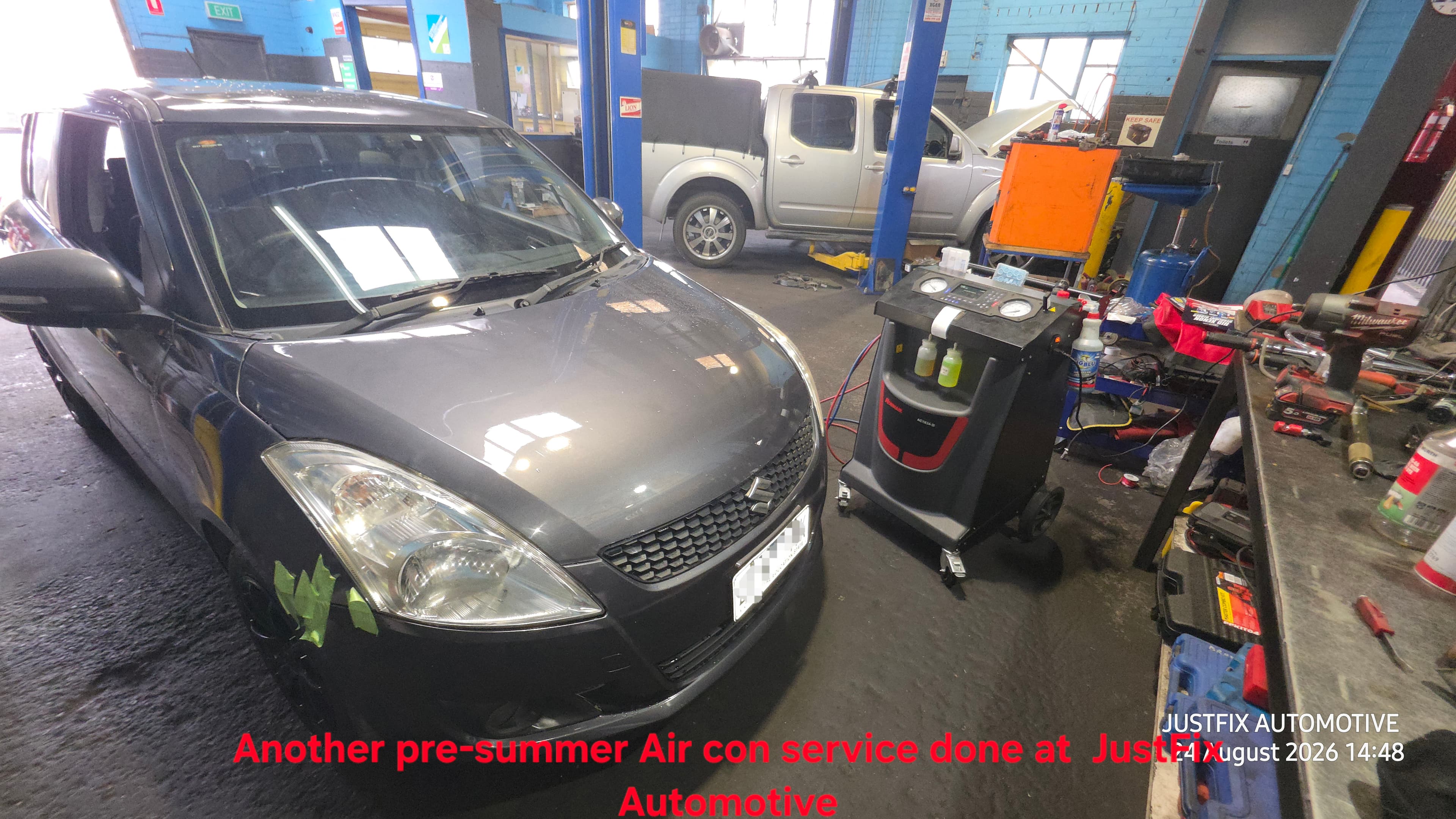
An aircon regas is the process of recovering any remaining refrigerant from the system, evacuating the system under vacuum to remove moisture and contaminants, and recharging with the correct refrigerant to the manufacturer's specified weight. It is carried out using a dedicated refrigerant recovery and recharging machine.
A regas is the appropriate service when:
The system has lost refrigerant over a long period through normal micro-permeation (a very slow, normal process in rubber hoses and seals over many years)
A minor leak has been repaired and the system needs recharging
The refrigerant has become contaminated and needs replacing
A regas alone is not the appropriate solution when:
There is a refrigerant leak that hasn't been identified and repaired — the new refrigerant will leak out
The compressor has failed — a regas won't restore cooling without a functioning compressor
There is a blocked expansion valve or condenser — the physical obstruction must be cleared first
There is an electrical fault preventing compressor engagement
Workshops that advertise very cheap regas pricing are either using the wrong gas, not doing the job properly, or hiding the real price until you arrive.
At JustFix Automotive, a regas is always preceded by a proper diagnosis. We don't recommend a regas if a leak hasn't been addressed — because it won't work, and you'll be back in weeks spending the same money again.
R134a vs R1234yf — What Refrigerant Does Your Car Use?
This is one of the most common questions we receive, and it directly affects the cost of an aircon regas.
R134a and R1234yf are the two refrigerant gases used in car air conditioning. The key thing to know is that they are not interchangeable — using the wrong refrigerant can lead to system damage, warranty voiding, or safety hazards.
R134a is the older refrigerant, used in most vehicles manufactured before approximately 2014–2017. It has a Global Warming Potential (GWP) of 1,430 and is being progressively phased out under Australia's environmental obligations under the Kigali Amendment to the Montreal Protocol.
R1234yf is the newer, lower-environmental-impact refrigerant, with a GWP of less than 1 — approximately 1,430 times more environmentally benign than R134a. R1234yf costs several times more per kilogram than R134a, and requires a separate, dedicated air-conditioning machine with additional safety features — a workshop cannot legally run it through the same equipment as R134a.
Which refrigerant your car uses is determined by its build date and manufacturer specification — it is printed on a sticker in the engine bay on most vehicles, and we can also identify it from your vehicle's VIN and compliance plate details.
A car aircon regas in Australia in 2026 costs approximately $170–$199 for older R134a systems and around $249–$329+ for newer vehicles running R1234yf. The newer refrigerant is far more expensive per kilogram and requires its own certified recovery machine.
At JustFix Automotive, our aircon regas starts from $200 + GST. We carry both R134a and R1234yf refrigerant and the dedicated equipment for each — so whatever your vehicle requires, we're equipped to service it correctly.
Why Does It Matter That JustFix Automotive Is ARC Licensed?
You need a Refrigerant Handling License to do anything with a regulated refrigerant that could cause leakage. Handling regulated refrigerant without a license is an offence under the Ozone Protection and Synthetic Greenhouse Gas Management Regulations 1995. The ARC (Australian Refrigeration Council) administers these regulations.
JustFix Automotive holds ARC Refrigerant Handling License AU066912. This means:
We are legally authorized to recover, handle, and recharge automotive refrigerant in Australia
We use dedicated recovery and recharging equipment that recovers refrigerant rather than venting it to atmosphere (venting is illegal and environmentally damaging)
Our refrigerant handling meets the requirements of the Australian Automotive Code of Practice
We use refillable containers for refrigerant storage as required by law
We maintain records of all refrigerant handling as required
Not every workshop that advertises aircon services holds this license. When you choose a workshop for your car's air conditioning, checking that they hold an ARC Refrigerant Handling License protects you legally, environmentally, and ensures the work is carried out correctly. You can verify any license at arctick.org.
How Does Melbourne's Climate Affect Your Car's Aircon?
Melbourne's western suburbs experience some of the most demanding conditions for automotive air conditioning in Australia — and most drivers don't realize it until the system fails.
Summer temperatures in Sunshine North, Keilor Downs, Deer Park, and Caroline Springs regularly reach 35–40°C, placing maximum demand on the system at the same time school runs, Ballarat Road commutes, and suburban stop-start driving are creating the worst possible conditions for compressor thermal management.
Australia's extreme temperature variations cause rubber seals to expand and contract repeatedly, making refrigerant leaks more common here than in more temperate climates.
The temperature swing between a winter morning park (4°C) and a summer afternoon in Sunshine North (39°C) subjects every O-ring, hose, and seal in the system to repeated thermal cycling. Over five to ten years, this is why even well-maintained vehicles develop slow aircon leaks that worsen each summer.
Winter is also when aircon problems are often overlooked — and when the system's critical role in demisting the windscreen becomes most apparent. The dehumidifying function of the aircon is what clears your windscreen on cold, damp mornings. A system that's low on refrigerant in summer won't demist effectively in winter either.
How Often Should Car Air Conditioning Be Serviced?
Most manufacturers recommend a car aircon service — including a cabin filter replacement and system check — every 12 months or 20,000–25,000 km. A full regas is typically needed every two to three years, though this depends on the vehicle, its age, and the condition of its seals.
Signs your system is due for a service regardless of interval:
The air from the vents isn't as cold as it used to be
The system takes longer to cool the cabin than it previously did
There's a musty or stale smell when the aircon is switched on (usually a mold or bacteria build-up on the evaporator)
The windscreen takes noticeably longer to demist in winter
The compressor makes a noise when the aircon engages
At JustFix Automotive, an aircon check is included in every logbook and major service — we report on system performance, cabin filter condition, and compressor operation as standard.
Aircon Repairs at JustFix Automotive — What We Can Fix
We carry out the full range of automotive aircon repairs in-house at our Sunshine North workshop:
Refrigerant regas — full recovery, vacuum evacuation, and recharge to manufacturer specification. R134a and R1234yf both available. From $200 + GST.
Leak detection and repair — UV dye injection and electronic detection, nitrogen pressure testing, O-ring and seal replacement, hose repair and replacement.
Compressor replacement — full compressor supply and fit, oil charge verification, system flush where required, and recharge. All makes and models including hybrid electric compressors.
Condenser repair and replacement — clean, repair or replace condensers damaged by road debris or corrosion.
Evaporator repair and replacement — behind-dash evaporator access, repair or replacement where inspection confirms a fault.
Expansion valve replacement — diagnosis and replacement of blocked or failed expansion valves.
Blower motor replacement — supply and fit of replacement blower motors where airflow is insufficient.
Cabin air filter replacement — standard replacement as part of any service or aircon inspection.
Climate control diagnostic scan — full system fault code reading and interpretation using professional diagnostic tools, including manufacturer-specific codes on European vehicles.
EV and hybrid aircon — electric compressor diagnosis and repair on hybrid HEV, PHEV, and full EV vehicles.
Serving Aircon Customers Across Melbourne's Western Suburbs
JustFix Automotive is based at 120 Munro Ave, Sunshine North VIC 3020 — conveniently accessible for drivers from across:
Sunshine North · Sunshine · St Albans · Keilor · Kealba · Keilor Downs · Albion · Cairnlea · Braybrook · Ardeer · Deer Park · Caroline Springs · Taylors Hill · Delahey · Hillside
We're easy to reach via Ballarat Road from the inner west, the Western Ring Road from the north and east, and the Calder Freeway from Caroline Springs, Taylors Hill, and Hillside. Most aircon work is completed the same day.
Frequently Asked Questions — Car Aircon Sunshine North
Why is my car aircon not cold?
The most common causes of a car aircon not cooling are low refrigerant from a leak, a failed or failing compressor, a blocked condenser, a faulty cooling fan (particularly noticeable when stationary), an electrical fault stopping the compressor from engaging, or a blocked cabin air filter restricting airflow. A professional diagnosis is required to identify which cause applies before any repair or regas is recommended.
How much does a car aircon regas cost in Australia?
In Australia in 2026, a car aircon regas costs approximately $170–$199 for older R134a systems and $249–$329+ for newer vehicles using R1234yf refrigerant. At JustFix Automotive in Sunshine North, regas starts from $200 + GST. The price difference between R134a and R1234yf is driven by the refrigerant cost — R1234yf is approximately 7–10 times more expensive per kilogram.
What is the difference between R134a and R1234yf refrigerant?
R134a is the older refrigerant used in most vehicles manufactured before 2014–2017. R1234yf is the newer, environmentally friendlier refrigerant used in most modern vehicles, with a Global Warming Potential (GWP) of less than 1 compared to R134a's 1,430. The two refrigerants are not interchangeable — using the wrong gas can damage the system. R1234yf costs significantly more per kilogram and requires a separate, dedicated recovery and recharge machine.
Do I need a license to regas a car aircon in Australia?
Yes. Under the Ozone Protection and Synthetic Greenhouse Gas Management Regulations 1995, handling automotive refrigerant requires a Refrigerant Handling License issued by the Australian Refrigeration Council (ARC). This covers recovering, handling, and recharging refrigerant. JustFix Automotive holds ARC Refrigerant Handling License AU066912. Handling refrigerant without a license is a legal offence in Australia.
Can a car aircon regas fix my problem?
A regas will restore cooling if the system has lost refrigerant through normal seal micro-permeation over many years, or after a minor leak has been identified and repaired. A regas will not fix a failed compressor, a blocked expansion valve, a condenser fault, or an electrical fault. It also will not fix an active refrigerant leak — the new refrigerant will leak out the same way the old refrigerant did. This is why JustFix Automotive performs a diagnosis and leak test before recommending any regas.
How long does a car aircon regas take?
A standard aircon regas at JustFix Automotive takes approximately 45–60 minutes once the diagnosis is complete. If repairs are required before the regas (leak repair, O-ring replacement, compressor work), additional time is needed. We advise on timing when you book and contact you before carrying out any work beyond the original scope.
How often should a car aircon be serviced?
Most manufacturers recommend an aircon service check every 12 months or 20,000–25,000 km. A full regas is typically needed every two to three years, depending on the vehicle's age and seal condition. A cabin air filter replacement is recommended at least annually, or more frequently in dusty suburban conditions. JustFix Automotive checks aircon performance and cabin filter condition at every logbook and major service.
Why does my aircon smell musty when I turn it on?
A musty or stale smell from the aircon vents is almost always caused by mold or bacteria growing on the evaporator or inside the cabin filter housing. The evaporator surface is cold and damp when the aircon is running, which creates ideal conditions for microbial growth — particularly when the aircon is switched off while the evaporator is still wet. An antibacterial evaporator treatment and cabin filter replacement resolves this in most cases.
Why does my car aircon work on the highway but blow warm air in traffic?
Aircon that cools well at highway speed but blows warm at low speed or when stationary is a classic symptom of a cooling fan fault. The cooling fan forces air through the condenser when the vehicle is moving slowly or stopped. At highway speeds, ram air does this job — which is why the symptom is absent at speed. A fan motor, relay, fuse, or thermal switch fault is the usual cause.
Does JustFix Automotive service aircon on hybrid and electric vehicles?
Yes. JustFix Automotive services EV, hybrid (HEV), and plug-in hybrid (PHEV) air conditioning systems, including electrically-driven compressors. Hybrid and EV aircon systems require specialist diagnostic tools and knowledge — the compressor is electrically powered rather than belt-driven, and refrigerant system diagnosis must be approached differently. We have the tools and experience for these systems.
Is JustFix Automotive near St Albans and Keilor Downs?
Yes. JustFix Automotive is at 120 Munro Ave, Sunshine North — a short drive from St Albans, Keilor Downs, Kealba, Albion, and the surrounding western suburbs. Same-day and next-day appointments are available for aircon diagnosis and regas in most cases.
Car Aircon Not Working? Book a Diagnosis and Regas at JustFix Automotive.
Don't just get a regas — get a proper diagnosis first. At JustFix Automotive in Sunshine North, we find the actual cause, fix it, and then regas. Everything is quoted upfront. Nothing is done without your approval.
ARC License AU066912 · R134a & R1234yf · All makes and models · EV and hybrid systems
📧 info@justfixautomotive.com.au
📍 120 Munro Ave, Sunshine North VIC 3020
🌐 justfixautomotive.com.au/book
Hours: Mon–Fri 8:00am–5:30pm | Sat 9:00am–3:30pm
Sunday, Christmas Day, Boxing Day & Good Friday: Closed
Other public holidays: Saturday hours apply
💳 EFTPOS · Visa · Mastercard · Amex · PayID · Afterpay · Zip Money · Humm · Bank Transfer